
Imagine walking into the same living room twice. The furniture is unchanged, the walls are the same, the windows bring in the same amount of daylight, and even the artwork is in exactly the same place. Yet the first room has a pale marble floor with gentle veining, while the second has a darker stone with dramatic movement running across it. The room would not feel the same.
That is the part of interior design that is easy to underestimate: the floor is not simply underneath everything else. It quietly influences everything you see above it.
Marble is particularly capable of doing this because it combines colour, natural pattern, reflectivity and scale in a single surface. A softly veined white marble can make a room feel brighter and more open, while a warm beige stone can make the same space feel more comfortable and grounded. A heavily patterned marble can become the visual focus of a room, whereas a restrained stone can allow furniture, artwork or architectural details to take centre stage.
And when marble is combined with a carefully designed border, medallion or custom inlay, the floor can move beyond being a material choice altogether. It can become part of the architecture of the room.
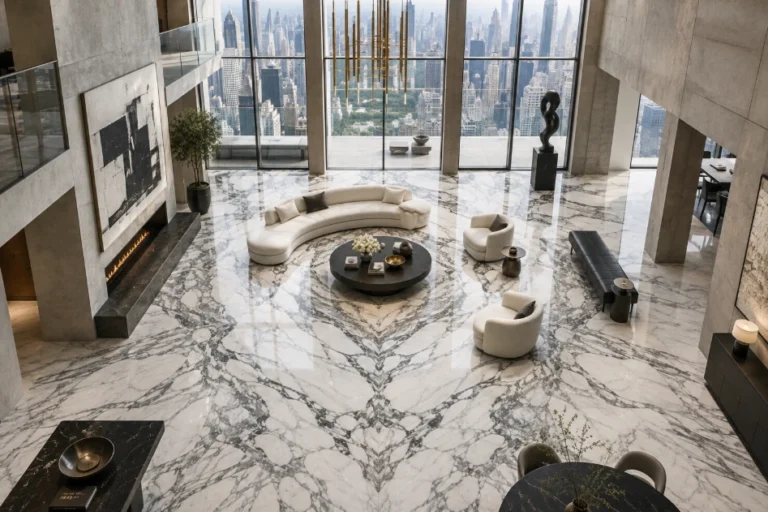
Why Does the Floor Have Such a Strong Effect on a Room?
Look around most rooms and you will notice how much visual information is competing for attention: furniture, curtains, lighting, artwork, wall finishes, doors and decorative objects. The floor is different. It is usually one of the largest continuous surfaces in the space, so even when you are not consciously looking at it, your eyes are constantly registering its colour, pattern and reflection.
That is why changing the floor can alter the character of a room without changing its layout.
A light marble floor can bounce daylight through the space and create a sense of openness. A darker floor can give furniture more contrast and make the room feel more intimate. Strong natural veining introduces movement, while a quieter marble creates a calmer background.
The effect becomes even more noticeable in open-plan homes, where the same flooring may travel from the entrance into the living room, dining area and connecting spaces. Instead of seeing several unrelated surfaces, the eye reads the areas as parts of one larger interior.
So when choosing marble flooring, the question should not simply be “Which marble looks beautiful?”
A better question is:
“What do I want this room to feel like when everything else is finished?”
That answer can lead you toward a very different stone.
Can Marble Flooring Make a Room Look Bigger?
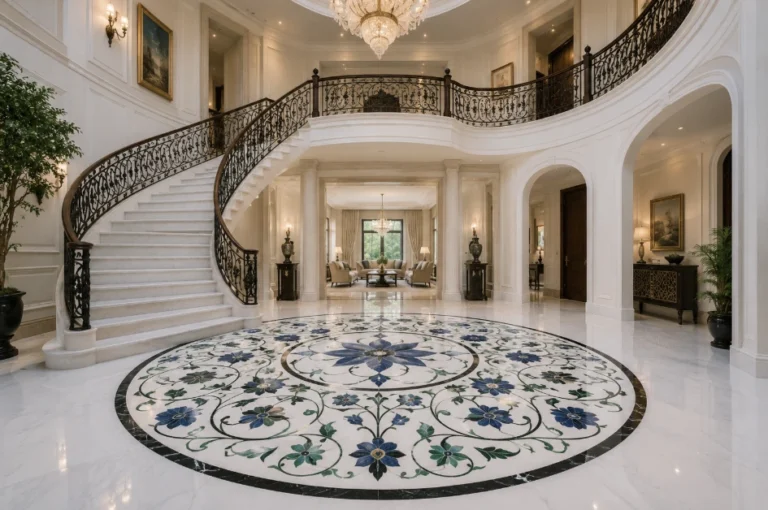
It can, although it is important to understand what is actually happening.
Marble cannot increase the physical dimensions of a room, but the right combination of colour, slab size, layout and continuity can make the space appear more expansive. Light-coloured marble tends to reflect more light, while larger pieces and fewer visual interruptions can create a more continuous surface.
This becomes particularly useful in living rooms that open into dining areas or hallways. If the same marble continues through these connected spaces, there are fewer changes for the eye to process, which can make the interior feel more unified.
The choice of pattern matters too. A small room covered in a very busy marble pattern may feel visually crowded even if the stone itself is light. In contrast, a calmer marble with well-planned joints can create a cleaner visual flow.
This is why simply searching for the best marble flooring for a small room can be misleading. There is no single marble that automatically makes every small room look larger. The result depends on how the stone works with the dimensions, light and architecture of that particular space.
The Marble's Veining Can Change the Mood Before You Add a Single Decoration
One of the reasons natural marble remains so visually interesting is that the stone already contains its own pattern. Some varieties have extremely subtle movement, where the surface appears almost uniform until you look closely. Others have bold veins that travel across the stone and create a dramatic composition. Neither is necessarily better; they simply produce different rooms.
If your furniture is sculptural, your walls contain artwork or your lighting is already dramatic, a softly veined marble may provide the balance the room needs. The floor remains luxurious without competing for attention.
But imagine a large, relatively restrained living room with simple furniture and plenty of open floor area. Here, a more expressive marble can become part of the room’s identity. Its natural movement provides visual interest without requiring additional decoration.
This is also where slab selection becomes important. With a highly patterned marble, the individual pieces should not simply be selected at random and placed wherever they fit. Their veining, orientation and relationship with neighbouring pieces can influence the finished appearance considerably.
In a large luxury interior, carefully selected and positioned marble can almost behave like a piece of artwork spread across the floor.
White, Beige or Grey Marble: Which Changes a Room the Most?
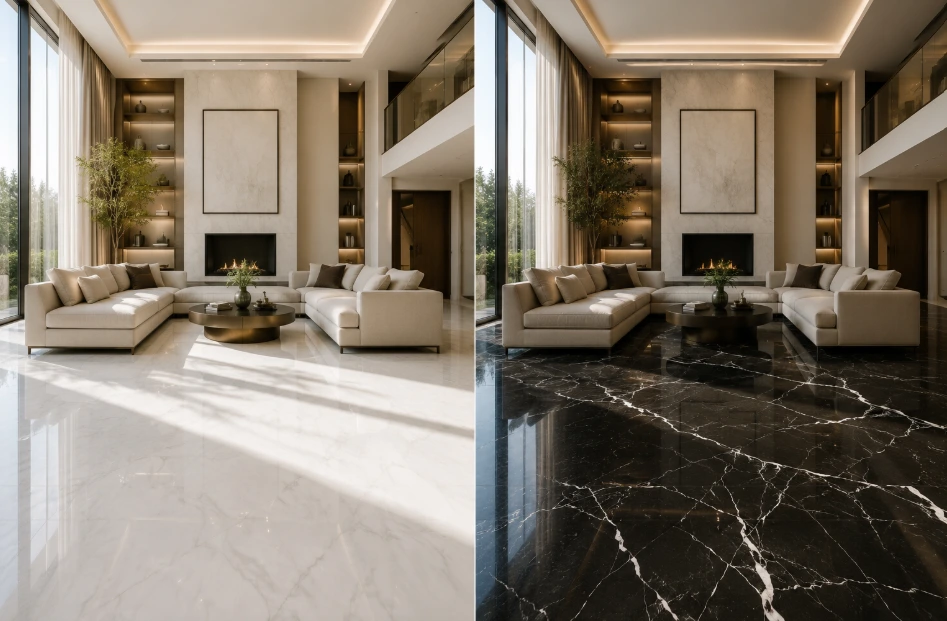
White marble for brightness and openness
White marble is often chosen when homeowners want a clean, luminous interior. Its lighter surface can work particularly well in spaces where natural light is already available, and subtle veining prevents the floor from looking completely flat.
In a contemporary living room, white marble can create a crisp foundation for wood, neutral upholstery and carefully selected metal accents. In a more traditional interior, the same colour family can look completely different when combined with ornate furniture and decorative architectural details.
Beige and cream marble for warmth
Warm-toned marble can soften an interior.
Creams, beiges and warmer neutral stones generally sit comfortably beside timber, textured fabrics and warm lighting. They can be especially effective when the goal is to create a luxurious home that feels welcoming rather than overly formal.
Grey marble for an architectural character
Grey introduces a cooler, more contemporary quality. It can work particularly well with black metal, glass, minimal furniture and clean architectural lines.
The important thing is not to choose the colour in isolation. The same grey marble can look sophisticated in one room and cold in another depending on the natural light and surrounding materials.
Dark marble for drama
Dark marble has a much stronger visual presence. Used carefully, it can create depth and contrast, particularly when paired with lighter walls or furniture.
But because dark stone carries more visual weight, it needs to be considered in relation to room size and lighting. A dramatic dark floor may be spectacular in a spacious entrance but unnecessarily heavy in a small, poorly lit room.
Difference between a Polished or Honed Finish Make
Two floors can use the same marble and still produce noticeably different impressions because the surface finish changes how light interacts with the stone.
- A polished finish has a reflective quality that can make the marble appear brighter and more formal. In a grand entrance or a traditional luxury living room, that sheen can reinforce the sense of occasion.
- A honed finish is quieter. Because it reflects less light, the natural colour and texture of the marble tend to feel softer and more understated.
Neither finish should be selected purely because one looks more luxurious in a photograph. Think about how the room is actually used, how much natural light it receives and whether you want the floor to announce itself or quietly support the rest of the interior. The finish is therefore part of the room’s character, not merely a technical specification.
When the Floor Becomes the Focal Point
There is a point at which marble flooring stops functioning as a background and begins competing with the furniture for attention. That is not necessarily a problem. In the right room, it can be exactly what you want.
A dramatic marble with strong movement can establish a focal point without adding another object to the room. A carefully selected slab can draw the eye across the floor, while bookmatched pieces can create a deliberate symmetrical composition.
The trick is knowing when to stop.
If the marble is already visually powerful, the furniture and walls do not necessarily need equally strong patterns. Luxury often comes from this balance: one element makes the statement while the others give it room to breathe. This principle becomes even more important when decorative marble inlay is introduced.
Can Marble Inlay Change the Character of a Floor
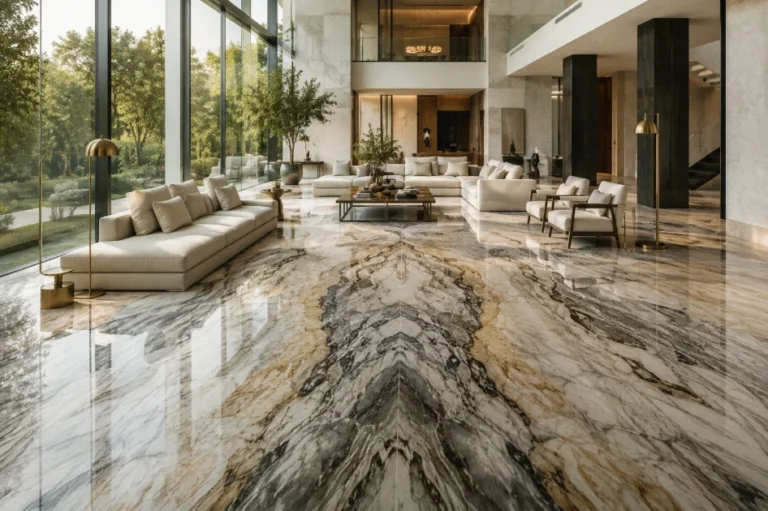
Natural marble already gives you colour and movement. Marble inlay gives you the ability to design the pattern deliberately.
Instead of accepting only the natural veining of the stone, contrasting marble and other materials can be cut into precise shapes and fitted into a prepared design. The result can range from a simple border to an elaborate medallion or a larger composition covering a substantial area.
Attari Marble Art works with custom marble inlay flooring, including borders, floor designs and patterns developed for individual projects. The company’s work also extends to other architectural surfaces such as stairs, walls and doors.
This changes the question from:
“Which marble should I put on the floor?”
to:
“What should the floor say about this room?”
A geometric border can give a formal room a stronger architectural structure. A floral design can introduce traditional craftsmanship. A central medallion can establish a visual centre in a large foyer. A restrained line of contrasting stone can quietly define the boundary between spaces.
The possibilities become much broader once the floor is treated as a designed surface rather than a collection of tiles.
Marble Flooring Work With the Furniture
The floor and furniture should be considered together.
- If you have a large sofa, statement chairs, patterned upholstery and artwork competing for attention, a highly dramatic marble floor may make the room feel unnecessarily busy. A calmer marble can provide the visual space those elements need.
- The opposite can also be true. If the furniture is simple and the walls are relatively quiet, the floor may be given more responsibility. This is particularly noticeable in luxury interiors where the floor is visible from several viewpoints. You might first see it from the entrance, then from the seating area and again while moving toward the dining room.
- A well-planned marble floor should make sense from all of these viewpoints. It should not look beautiful only when photographed from directly above.
Which Marble Flooring Works Best for Different Rooms?
There is no universal answer because different rooms place different demands on the floor.
Living rooms
Living rooms offer the most freedom. A softly veined marble can create an elegant background, while a dramatic stone or custom inlay can turn the floor into a focal feature.
Entrance foyers
The entrance is often where a decorative floor makes the strongest first impression. Borders, medallions and custom marble inlay can establish a design language before a visitor has even entered the main living space.
Dining rooms
A dining room can accommodate a stronger floor pattern when the furniture is relatively restrained. A border or central design can also help define the dining area within a larger open-plan space.
Bedrooms
Bedrooms usually benefit from a quieter approach. Warm marble tones, subtle veining and less reflective finishes can create a softer environment than highly dramatic stone.
Connecting spaces
Hallways and transitions are often overlooked, but they can determine whether the rooms of a home feel connected. Continuing the same marble or adapting its border treatment can create a much stronger sense of flow.
Attari’s marble inlay work has also been applied to spaces such as entrances, living areas, pooja rooms and other architectural interiors, where the floor is intended to contribute to the overall design rather than simply cover the surface.
Can You Change the Character of a Room Without Completely Redesigning It?
Sometimes, yes.
This is one of the reasons flooring can be such a powerful part of renovation. You do not necessarily need to replace every piece of furniture or rebuild the architecture to change the atmosphere of a room. A new floor can alter the amount of reflected light, introduce a different colour palette and create a new visual relationship between connected spaces.
However, flooring should not be treated as an isolated renovation decision either.
If the existing walls, furniture and lighting strongly conflict with the new marble, the transformation may not feel as complete as expected. The best results usually come from identifying the few elements that need to change around the floor rather than trying to redesign everything.
What Makes a Marble Floor Feel Custom Rather Than Ordinary?
It is rarely just the price of the marble. A floor can feel special because the stone has been selected carefully, the pieces have been laid with attention to their relationship, the joints are well considered and the overall composition responds to the room.
Custom inlay takes that idea further.
Instead of simply choosing from a fixed catalogue of patterns, a design can be developed around the dimensions and character of the space. This is particularly valuable in a luxury home where the homeowner is not looking for a floor that simply looks expensive. They want something that belongs to their space.
The Floor Should Support the Room – or Become Part of Its Story
There is no single correct way to use marble.
Sometimes the best marble floor is the one you barely notice because it creates exactly the right background for the furniture and architecture.
Sometimes the floor deserves to be the first thing visitors notice.
A quiet cream marble can make a room feel warm and timeless. White marble can open up a darker interior. Grey can reinforce a contemporary architectural style. Dramatic veining can become artwork. A carefully designed inlay can give an otherwise simple room an identity of its own. The important decision is therefore not simply about finding the most luxurious marble.
It is about understanding what role the floor should play.
At Attari Marble Art, traditional marble inlay craftsmanship is adapted to custom architectural applications, allowing the floor to become more than a finished surface. Whether the design calls for a restrained border, a central medallion, a geometric composition or a more elaborate custom pattern, the objective is to make the work belong naturally to the space.
Because when marble flooring is selected thoughtfully, the transformation is not really about the floor alone.
The floor changes how the room is seen – and that can change how the entire room feels.
