
Interior Transformation Custom Marble Inlay Over Existing Floors
Can You Install Custom Marble Inlay Over Existing Floors?
A beautiful new floor can completely change the character of a room, but there is one part of a flooring renovation that many homeowners would happily avoid: removing the floor that is already there.
The thought of breaking existing marble or tiles, carrying out the debris, dealing with dust throughout the house and then rebuilding the floor from scratch can make even a desirable renovation feel unnecessarily disruptive. This is especially true when the existing floor is still in reasonably good condition. Perhaps it is structurally sound but looks dated, perhaps it is plain and no longer suits the interior, or perhaps you simply want to introduce a custom marble inlay design without turning the entire room into a construction site.
That naturally leads to a question we hear often in different forms:
Can custom marble inlay be installed over an existing floor?
The answer is sometimes. An existing floor can potentially be retained when it provides a suitable, stable foundation for the new installation, but it should never be assumed that any old tile or marble surface can simply be covered with a new layer of marble. The condition of the existing floor, its level, moisture condition, bonding, available floor height and the proposed installation system all have to be considered first. Current guidance for installing new flooring over existing tile makes the same fundamental point: the old surface needs to be sound, firmly bonded and suitable for the additional layer.
So the real opportunity is not simply putting marble over an old floor. It is finding out whether your existing floor can become the foundation for a carefully planned interior transformation.
Why Keeping the Existing Floor Can Be So Attractive
For a homeowner, the appeal is obvious.
Removing a floor is rarely limited to the few hours of actual demolition. Furniture has to be moved, dust and debris have to be controlled, waste has to be removed, and the exposed surface underneath may then need repairs or preparation before the new floor can even begin. If the room connects directly to other parts of the house, the disruption can extend well beyond the area being renovated.
Retaining a suitable existing floor can eliminate a significant part of that process. When an old floor is stable and appropriate for an overlay system, there is no need to demolish it simply because its appearance has become outdated. Flooring professionals commonly identify reduced demolition, waste, dust and disruption as some of the main reasons homeowners consider installing a new surface over an existing one.
That does not mean the renovation becomes completely mess-free. The existing surface may still need thorough cleaning, preparation, repairs or mechanical treatment, and the installation of a custom marble surface involves cutting, fitting and finishing. But avoiding unnecessary demolition can make a substantial difference to how disruptive the overall project feels.
For a lived-in luxury home, that difference can be important.

The First Question Is Not “Which Marble Do You Want?” — It Is “What Is Underneath?”
This is where a good renovation project begins.
Before discussing patterns, borders or marble colours, the existing floor needs to be assessed. Is it firmly bonded? Is it flat enough? Are there areas that sound hollow or feel loose? Are there significant cracks? Has the room experienced water seepage? Is the existing surface already too high in relation to doors and adjoining rooms?
These questions matter because a new floor does not erase problems underneath it.
If the existing tiles are loose or extensively cracked, putting a new surface over them simply hides the problem. Likewise, if there is unresolved moisture below the floor, covering it does not make the moisture disappear. Current installation guidance consistently recommends removing or addressing an unsuitable existing floor rather than building a new finish over a failing base.
A sound existing floor, on the other hand, can be a very different proposition. If it is stable, reasonably level and free from underlying problems, an overlay-based renovation may be worth considering.
This is why an experienced installer should inspect the floor before promising an overlay. The condition of the existing floor—not simply its material—is what determines whether the idea is practical.
What Kind of Existing Floor Can Be Considered?
Homeowners often ask whether their existing marble, ceramic tile or vitrified tile can be covered. There is no universal yes or no because two floors made from the same material can be in completely different conditions.
A well-bonded marble floor that has been maintained for years may provide a very different starting point from a tile floor with loose sections and hollow areas. Similarly, a clean, stable surface may be suitable for preparation, while a floor with significant unevenness or moisture problems may need to be removed.
Smooth or glazed tile surfaces can also require specific preparation before another material can be bonded to them. Industry guidance on tile-over-tile installation highlights cleaning, surface preparation, bond and flatness as important considerations rather than treating the existing tiles as automatically ready for the next layer.
For that reason, it is better to think of an existing floor as a potential substrate rather than simply an old floor.
If the substrate is right, retaining it can make sense.
If it is not, removing it may actually be the lower-risk and more economical decision in the long term.
The Floor-Height Problem: The Detail That Can Change the Entire Decision
There is another issue homeowners often discover too late: the new floor will sit higher than the old one.
Even when the additional height seems small, it can affect doors, thresholds, skirting, built-in furniture, steps and transitions into rooms that are not being renovated. Current guidance for flooring over existing surfaces specifically recommends checking these clearances before installation because the additional layer can create practical problems.
Imagine completing a beautiful custom marble floor and then discovering that a bedroom door no longer opens properly, or that the transition into the hallway has become an awkward step. These are not design problems; they are planning problems.
This is why the proposed finished floor level should be considered at the beginning of the project.
The question is not simply whether the old floor can physically remain underneath. It is whether the entire room still works once the new floor is installed.
What Does “Low-Mess” Actually Mean?
A low-mess renovation should not be confused with a renovation that creates no dust, noise or preparation work.
If the existing floor is retained, you may avoid the most disruptive activity: breaking out the old material and carrying large quantities of debris out of the house. That can reduce the amount of demolition, shorten the disruptive phase and make it easier to keep adjoining areas operational.
But the new installation still requires preparation.
The existing floor may need to be cleaned and treated so the new system can bond correctly. Uneven areas may need attention. Existing defects may need to be repaired. Marble and inlay components need to be cut, fitted and finished, and the surrounding space still needs appropriate protection during the work.
The difference is that you are potentially replacing a full demolition-and-rebuild process with a more controlled transformation of the existing surface.
That can be particularly valuable when renovating an occupied home, a finished luxury interior or a room connected to several other spaces.
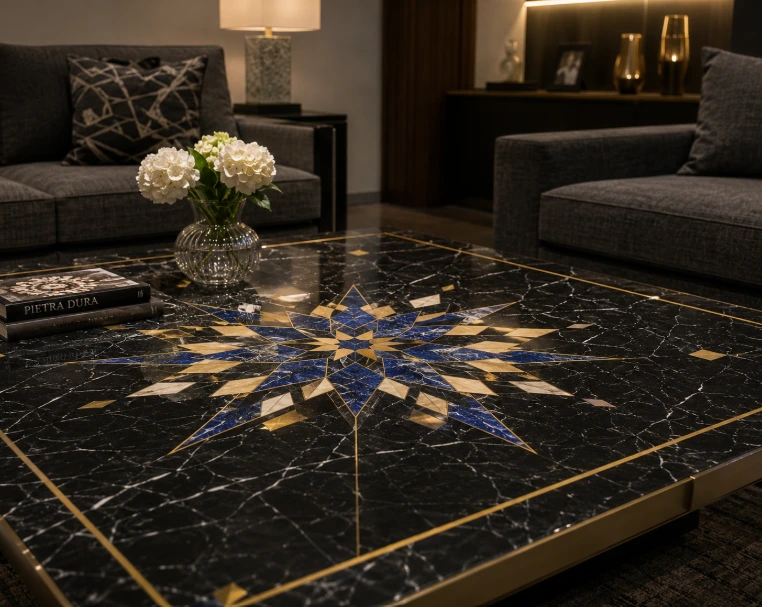
What a Low-Mess Marble Inlay Transformation Can Look Like
- When the existing surface is suitable, the project can follow a much more controlled path than a conventional floor replacement.
- First, the existing floor is assessed and the installation conditions are established. The design is then developed around the dimensions of the room, the architecture and the homeowner’s preferred style. Marble and inlay materials are selected before the individual pieces are fabricated to the approved design.
- Once the site is prepared, the components can be fitted according to the planned layout, followed by the necessary finishing and surface treatment.
- The exact method depends on the floor and the chosen design, which is why a custom project should not be reduced to a fixed installation recipe.
- The important thing is that the design and the installation method are developed together.
- That is particularly true for detailed marble inlay, where alignment, scale, material selection and finishing all contribute to the final appearance.
You Don't Always Have to Redesign the Entire Floor
There is another possibility that homeowners sometimes overlook.Perhaps the existing marble floor is perfectly good, but it feels too plain. The problem may not be the entire floor—it may simply lack a design element that gives the room identity.
In that situation, a custom marble inlay border, medallion or selected decorative area may be worth considering instead of completely replacing the floor.
A border can frame the room and give a plain surface more definition. A medallion can establish a focal point in an entrance or large living area. A geometric detail can connect the floor with architectural features elsewhere in the room. Inlay specialists commonly use these approaches for existing interiors and renovation projects, including borders, medallions and full-floor designs.
This can be an especially effective approach when the homeowner wants a transformation but does not want the floor to become excessively decorative.Sometimes the most successful renovation is not the one that changes everything.
It is the one that changes the right part.
What Can Custom Marble Inlay Add to an Existing Interior?
This is where the project becomes much more interesting than a conventional floor replacement.Marble already has natural colour, veining and movement. Custom inlay allows those characteristics to be combined with a deliberate design. Contrasting marble, coloured stones, semi-precious materials, mother of pearl or brass can be incorporated into a larger composition depending on the design and application.
The pattern could be subtle enough to work with a contemporary interior, or more elaborate where the architecture calls for traditional craftsmanship.
Attari Marble Art’s marble inlay work includes custom flooring designs, borders and other architectural applications, with designs developed for individual projects rather than being limited to a standard flooring pattern.
That means an existing floor renovation can start from the character of the room you already have.
If the furniture is contemporary, the inlay can be geometric and restrained. If the home has more classical architecture, a floral or ornamental composition may feel more appropriate. If the entrance is large, a central medallion may create a stronger first impression than a pattern repeated across the entire floor.
The design should respond to the room rather than simply demonstrate how much decoration can be fitted into it.
How Does the Design Process Change When the Floor Already Exists?
A new-build floor gives the designer more freedom because the entire surface can be planned from the beginning. An existing floor introduces another layer of information: its dimensions, joints, levels, doorways and architectural boundaries are already fixed.
That is not necessarily a disadvantage.
In fact, those constraints can make the design more thoughtful.
The inlay can be positioned around furniture rather than underneath it. A border can align with door openings. A central motif can be scaled according to the actual room rather than a generic catalogue image. If adjoining spaces are being retained, the design can be developed so that the transition feels intentional.
Attari’s published approach to marble inlay involves design development, material selection, cutting and shaping of individual pieces, fitting and finishing. For an existing-floor renovation, these stages become particularly important because the design has to respond to the conditions already present on site.
The best result is therefore not necessarily the most elaborate pattern.
It is the pattern that looks as though it was always meant to be there.
What Happens If the Existing Floor Is Not Suitable?
This is where an honest marble specialist should be willing to say no.
If the existing surface has widespread loose areas, significant structural cracking, persistent moisture problems or substantial unevenness, retaining it simply to avoid demolition may create more risk than benefit. Similarly, if the additional floor height causes unacceptable problems with doors, steps or transitions, an overlay may not be the right solution.
In those cases, removing the old floor and preparing a proper base may be the better route.
That may sound less attractive when the original goal was a low-mess renovation, but it is better to discover this before installation than after an expensive custom marble floor has been completed.
A custom inlay floor is a significant investment. The desire to save demolition should never outweigh the need for a stable foundation.
Is Installing Marble Over an Existing Floor Cheaper?
It can reduce some renovation costs because demolition, disposal and certain preparation work may be avoided, but it should not automatically be described as a cheaper option.
Custom marble inlay is itself a highly detailed craft. The final cost can depend on the area, marble selection, pattern complexity, number and type of inlay materials, fabrication, surface preparation, installation and finishing.
The economics therefore depend on the whole project.
If the existing floor is suitable and only a relatively small amount of preparation is required, retaining it may make financial and practical sense. If the existing surface needs extensive correction before the new floor can be installed, the savings can become much smaller.
This is why a quote based only on a per-square-foot marble rate does not tell the whole story.
The more useful question is:
What will it take to deliver the finished floor correctly in this particular room?
Can This Approach Work in a Luxury Home?
Yes,and in some cases, it can be particularly valuable.
Luxury homes are often already finished with carefully selected doors, walls, furniture, lighting and architectural details. The homeowner may not want to disturb all of those elements simply because the floor needs to be updated.Retaining a suitable existing floor can make it possible to focus the transformation where it matters.
A plain living-room floor can receive a restrained geometric border. An entrance can gain a custom medallion. A large open-plan area can receive a carefully positioned inlay composition. A dated marble floor can be given a new visual language without automatically treating the entire room as a demolition project.
The result can feel less like a renovation and more like an interior transformation.
That distinction matters.
The goal is not necessarily to make the room look new.
It is to make the room feel right for the way it is designed today.
The Best Renovation May Be the One That Knows What Not to Remove
There is a tendency in renovation to assume that transformation requires starting again.
Sometimes it does.
But not always.
If your existing floor is stable, suitable and worth preserving, it may be possible to work with what is already there rather than automatically demolishing it. A carefully planned marble inlay border, medallion or custom design can introduce an entirely different character while avoiding some of the disruption associated with a complete floor replacement.
Attari Marble Art approaches marble inlay as a custom craft, with designs and material combinations developed for individual architectural applications. Its work includes marble inlay flooring and decorative applications where the pattern, stone selection and craftsmanship are part of the finished design.
That makes the first conversation less about “How much will it cost to put marble over my floor?” and more about:
“What can we realistically create with the floor I already have?”
Sometimes the answer will be a low-disruption transformation.
Sometimes the answer will be that the existing floor should come out.
Either way, the homeowner gets something more valuable than a quick yes: a solution based on the actual condition of the space.
And that is the right place to begin when the goal is to transform an existing interior with custom marble inlay.
