
15 Luxury Interior Design Ideas to Make Your Home Look Expensive
A home can contain expensive furniture and still fail to look luxurious. The reason is that luxury is not created by price alone. It comes from the way a space is proportioned, the quality of its materials, the relationship between architectural elements and the amount of thought behind the smallest details.
This is why some interiors immediately feel sophisticated while others feel like a collection of costly products. In a successful luxury interior design scheme, the floor, walls, furniture, lighting and decorative elements work together rather than competing for attention.
The good news is that making a home look expensive does not always require a complete renovation. Often, the biggest improvement comes from identifying the elements that have the greatest visual influence and treating them with more care.
15 Luxury Interior Design Ideas That Make a Home Look Expensive
1. Make the Entrance Create an Immediate Impression
The entrance establishes expectations for everything that follows. A well-designed foyer can make an ordinary home feel considerably more sophisticated before a visitor has even entered the main living area.
Instead of filling the entrance with accessories, concentrate on the architectural elements people see first: the flooring, door, lighting, wall treatment and console.
A custom marble floor can be particularly effective in a generous foyer. A geometric inlay or carefully proportioned marble medallion can establish a visual centre and give the entrance an individual identity.
The important part is that the feature relates to the size and geometry of the foyer. A design that is too small can disappear, while an oversized pattern can make the entrance feel crowded.
2. Upgrade the Architectural Surfaces
Luxury is easier to achieve when the architecture itself feels considered.
Walls, ceilings, door surrounds, niches and built-in elements create the permanent framework of a room. Improving these surfaces can therefore have a larger impact than continually changing accessories.
Depending on the style of the home, this might involve:
- A refined wall treatment
- Full-height doors
- Architectural niches
- Carefully detailed cabinetry
- Decorative ceiling elements
- Stone or marble feature surfaces
The objective is to make the structure of the room feel intentional rather than relying on decoration to hide an otherwise ordinary shell.
3. Treat the Floor as Part of the Architecture
Flooring is often selected after furniture and walls, even though it covers one of the largest surfaces in the home.
An expensive-looking interior considers the floor as part of the architectural composition. The direction of the material, scale of the slabs, transitions between spaces and relationship with furniture all matter.
Natural marble can provide a strong foundation, while custom marble inlay can be used to define specific zones or introduce a bespoke design.
Rather than applying an elaborate pattern across every room, consider where the floor has enough space and visibility for craftsmanship to be appreciated.
4. Choose One Exceptional Natural Material
Luxury interiors benefit from materials with genuine visual character.
Natural marble is a good example because every piece has its own variation in veining, colour and movement. But the point is not simply to use the most expensive stone available. It is to select a material whose characteristics suit the room.
A dramatic marble might work as a statement wall or fireplace, while a quieter stone may be more appropriate across a large floor.
When one natural material has enough character of its own, the surrounding design can remain comparatively simple.
5. Introduce Craftsmanship That Cannot Be Mistaken for Mass Production
There is a difference between an expensive-looking finish and a genuinely bespoke detail.
Handcrafted marble inlay, custom stonework, carving or individually produced surfaces can introduce a level of specificity that standard finishes cannot easily reproduce.
For example, a marble-and-brass inlay can be developed specifically for an entrance, floor, wall or staircase rather than selected from a generic catalogue pattern.
This is where craftsmanship becomes more than decoration. It gives the interior something that belongs specifically to that home.
6. Turn the Staircase Into a Designed Feature
In a duplex or multi-storey residence, the staircase is too prominent to be treated purely as a functional structure.
Its treads, risers, railing, adjacent wall and lighting can all contribute to the interior design.
Marble can be introduced through the steps or risers, while brass or contrasting stone can provide carefully controlled detailing. A custom design can also connect the staircase visually with the flooring or entrance.
The result is a staircase that feels like part of the home’s architecture rather than an isolated construction element.
7. Give the Ceiling More Presence
The ceiling is one of the most overlooked opportunities in residential design.
Because people naturally concentrate on walls and furniture, an ordinary ceiling can make an otherwise sophisticated room feel unfinished. A thoughtfully designed ceiling can change the perceived proportions and atmosphere of the space.
Depending on the architecture, consider:
- Concealed lighting
- Coffered or recessed detailing
- Carefully proportioned ceiling planes
- Timber elements
- Architectural lighting channels
- A restrained change in material or finish
The ceiling does not need to become decorative. Its purpose is to complete the room from above and strengthen its architectural character.
8. Use Lighting to Create Atmosphere Rather Than Just Brightness
A room can contain beautiful materials and still look ordinary under poor lighting.
Luxury lighting is less about making the room brighter and more about controlling where light falls. Different layers can highlight architecture, create warmth and draw attention to selected materials.
Use a combination of:
- Ambient lighting for general illumination
- Accent lighting for artwork and feature surfaces
- Concealed lighting for architectural details
- Task lighting where activities require it
- Decorative fixtures where appropriate
This is particularly valuable for marble because directional or concealed lighting can reveal veining, texture and surface variation that may disappear under flat illumination.
9. Choose Furniture According to the Scale of the Room
Furniture should be selected according to proportion rather than simply according to how impressive an individual piece looks.
A very expensive sofa can look wrong if it is too small for a large room. Similarly, an oversized sectional can overwhelm a carefully designed space.
Consider the relationship between furniture and:
- Ceiling height
- Room dimensions
- Door and window proportions
- Walking routes
- Coffee tables and side tables
- Dining table and surrounding circulation
When these relationships are correct, the room naturally feels more balanced and complete.
10. Create Depth With Contrasting Textures
A luxury interior should not depend entirely on visual pattern.
Texture gives a room depth even when the colour palette is restrained. Smooth marble can be contrasted with natural timber, soft upholstery, woven fabrics, brushed metal or textured walls.
This creates a richer sensory experience without requiring numerous decorative objects.
The contrast is particularly effective when materials are used for different purposes. Stone can provide solidity, timber warmth, textiles softness and metal precision.
11. Develop a Clear Colour Story
Colour becomes more sophisticated when it has a hierarchy.
Instead of choosing individual colours independently, establish a dominant background, supporting tones and a small number of accents.
For example, warm neutral walls can work with natural timber, cream upholstery and darker furniture accents. Alternatively, cooler architectural finishes can be balanced with warmer wood or brass.
Marble should be considered within this palette. Its natural veining may introduce additional tones that need to be reflected—or deliberately contrasted—in the surrounding interior.
12. Use Large-Scale Soft Furnishings
Soft furnishings are sometimes treated as finishing touches, but they can significantly influence the perceived scale and comfort of a room.
Full-height curtains, appropriately sized rugs and substantial upholstery can make a space feel more complete.
Curtains that extend from close to the ceiling towards the floor can emphasise height. A rug that is correctly proportioned to the seating arrangement can visually connect furniture rather than leaving every piece floating independently.
These details add softness to hard architectural materials such as marble and stone.
13. Pay Attention to Hardware and Fixtures
Small elements are often responsible for making a room feel finished.
Door handles, cabinet hardware, taps, switches, sockets, curtain hardware and lighting fixtures may occupy relatively little space, but poorly selected versions can undermine an otherwise expensive interior.
Choose these details as part of the overall design rather than as last-minute purchases.
The goal is not necessarily to choose the most elaborate hardware. Simple, well-made details often work better because they reinforce the architecture without distracting from it.
14. Create Continuity Between Rooms
An expensive-looking home should feel like one residence rather than a series of unrelated rooms.
That does not mean every room needs identical furniture or finishes. Instead, repeat selected materials, colours, proportions or details.
For example, a marble used in the entrance might reappear in a staircase detail. A brass accent could connect the staircase to lighting fixtures. Timber from the living area could continue into cabinetry elsewhere.
These repeated references create a visual thread through the home and make the overall design feel intentional.
15. Edit the Interior Before Adding Anything Else
Once the major design decisions are complete, the final step is often subtraction.
Look at the room and identify anything that does not contribute to its purpose or appearance. Too many accessories, competing patterns, unnecessary furniture and unrelated finishes can make an expensive interior feel chaotic.
Before purchasing another decorative item, ask:
- Does the room actually need it?
- Does it improve the composition?
- Does it compete with an existing focal point?
- Does it contribute useful texture, function or character?
Sometimes removing one unnecessary element has more effect than adding another expensive one.
How to Combine These Ideas Without Making the Home Look Overdesigned
These 15 ideas are not meant to be applied equally throughout the house.
A successful luxury interior usually has a hierarchy. The architecture establishes the foundation, selected materials provide character, one or two elements become focal points, and furniture, lighting and accessories support the overall composition.
For example, a living room could combine a carefully designed marble floor with substantial furniture, layered lighting and a textured wall. The entrance might receive a more distinctive custom inlay, while the staircase could become the main feature of the circulation space.
The important thing is that each room has a clear design priority.
When every surface is treated as a statement, the interior becomes visually tiring. When the strongest elements are given enough space around them, they become much more impressive.
Where Custom Marble Can Strengthen a Luxury Interior
Marble is particularly valuable when it is used for a purpose rather than simply added because it is associated with luxury. For a residential project, custom marble work can contribute to different parts of the interior:
- Marble inlay flooring can define entrances, living spaces or important transitions.
- Marble medallions can create a central feature where the room has enough scale to support one.
- Brass inlay can introduce a precise metallic accent within a marble composition.
- Marble wall panels can strengthen fireplaces, staircases, entrances and other architectural features.
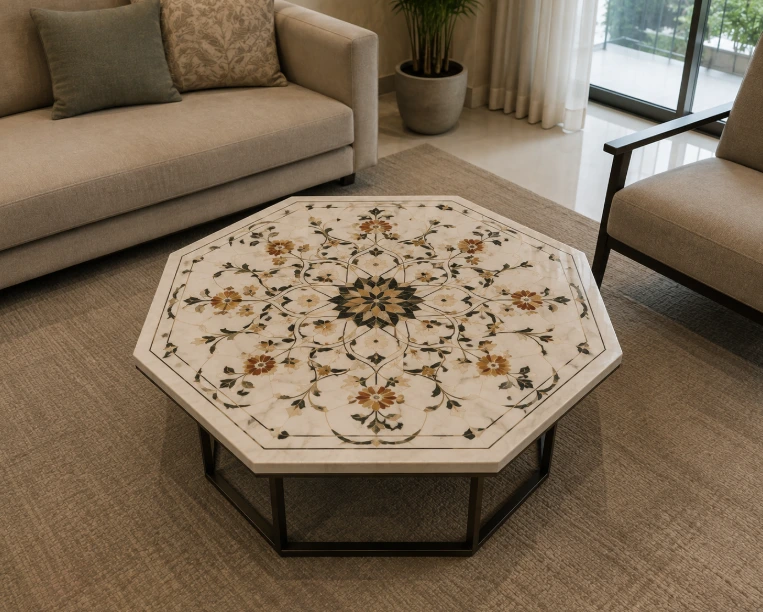
- Custom marble tabletops can introduce handcrafted stone into the furniture layer.
- Marble staircase detailing can turn a circulation element into part of the home’s visual identity.
The strongest result does not come from using all of these applications. It comes from identifying where custom craftsmanship will have the greatest effect.
What Makes a Home Feel Truly Luxurious?
The most successful luxury interiors are rarely the ones with the greatest number of expensive objects. They are the ones where the important decisions feel connected.
The flooring relates to the architecture. The furniture suits the scale of the room. Lighting reveals the materials. Colours work together. Custom details have a reason for being there. Nothing feels randomly added.
That is why luxury interior design is ultimately less about adding luxury and more about designing with intention.
Natural marble, custom inlay, handcrafted stonework and bespoke architectural details can certainly contribute to that feeling, but they become most effective when they are part of a larger design strategy.
A home looks expensive when it feels considered from the entrance to the smallest detail—and when the quality of the design remains visible even after the obvious signs of luxury have been removed.
